 Spectra
How-to · business setup
Start with a sellable route—not a room full of machines.
Choose a narrow offer, prove demand and design the production and installation controls before committing to expensive equipment.
Published by Spectra · no named expert reviewer is claimed · last reviewed 17 September 2026 · operational guidance, not technical, legal or safety certification.
The practical answer
A sensible first model is usually one repeatable customer problem, a documented survey-to-handover process and carefully selected trade partners. Buy equipment only when volume, margin, control or lead time justifies owning the process.
Offer
Choose the work before the kit.
Define the customer, sign type, geographic radius, average complexity and the outcome you can deliver consistently. Window graphics, vehicle lettering, site boards and internally produced rigid signs have different survey, artwork, production and installation demands.
- Write three representative jobs and their hand-offs
- Price from current supplier and labour evidence
- List what will be produced, bought in or subcontracted
- Set proof, change and payment controls
- Test a small volume before scaling
Operation
Design the safe route from enquiry to handover.
Document survey, estimating, proof approval, file control, material receipt, production checks, packing, installation and actual-cost review. Identify where competent technical advice, planning permission, electrical work or work-at-height control may be required.
Buy
Use a make-versus-buy trigger.
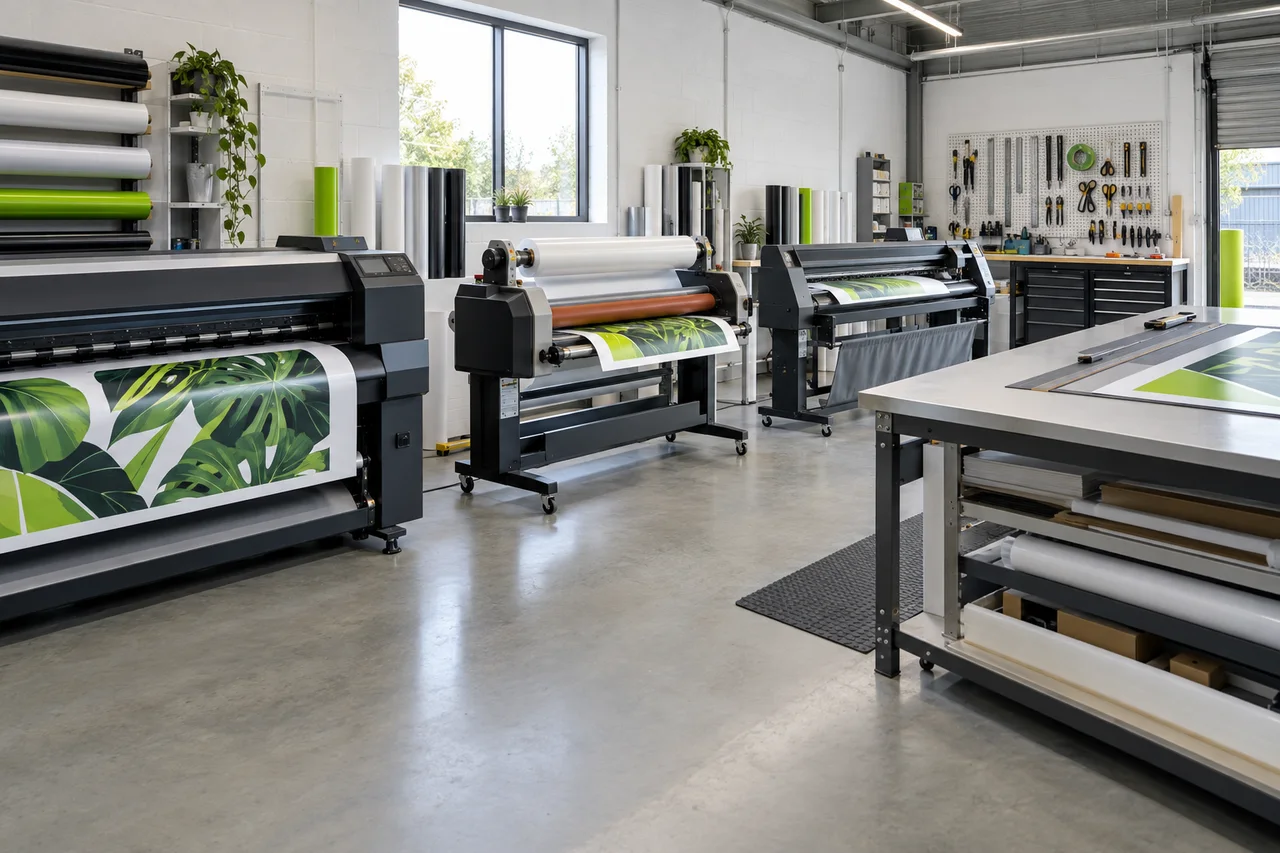
Compare external cost, lead time, rejected work, utilisation, space, power, ventilation, maintenance, training, finance and downtime. A printer purchase does not remove the need for finishing, colour control, cutting, packing or installation capability.
Safety
Treat workshop controls as part of the business model.
HSE says printing can involve hazardous substances including some inks and laminating adhesives, while PUWER requires work equipment to be suitable, maintained and used by people with adequate information, instruction and training. Build those duties into premises and equipment decisions.
A sample, not a promise